
What does a Virtual CFO actually do?
How senior finance support helps growing businesses make better decisions and plan ahead

Guide | September 2026
The changing role of finance as your business grows
When a business is small, finance is often about keeping things running: invoicing customers, paying suppliers and employees, meeting tax obligations and knowing what's in the bank. For many businesses, that's exactly what is needed at that stage.
But as a business grows, the questions owners need finance to answer start to change.
Which customers are actually profitable? Which products or services generate the strongest returns? What happens if costs rise by 10%? Can we afford another employee, piece of equipment or new location? What price do we need to maintain our margin? If we continue growing at this rate, what will the business look like in three or five years?
At this point, historical accounts alone aren't enough. The business increasingly needs finance to help understand what's happening, anticipate what might happen next and make better decisions about where to go from here.
That's where senior finance capability starts to become valuable. For many growing businesses, a Virtual CFO is one way to access that experience without employing a full-time CFO.
What is a Virtual CFO?
A Virtual CFO gives a business access to senior finance experience on a part-time basis, without needing to employ a full-time CFO. Despite the name, the support doesn't necessarily need to be virtual. It can be provided onsite, remotely or through a combination of both.
The type of support also varies. It might involve ongoing financial direction, forecasting and regular input into important decisions, or targeted support for a particular problem or project.
Not all Virtual CFOs offer the same expertise. Some specialise in cash flow and funding, others in accounting and financial control, while others have stronger experience in business performance, acquisitions and transactions, strategy, systems or particular industries.
The right fit therefore depends on what the business actually needs.
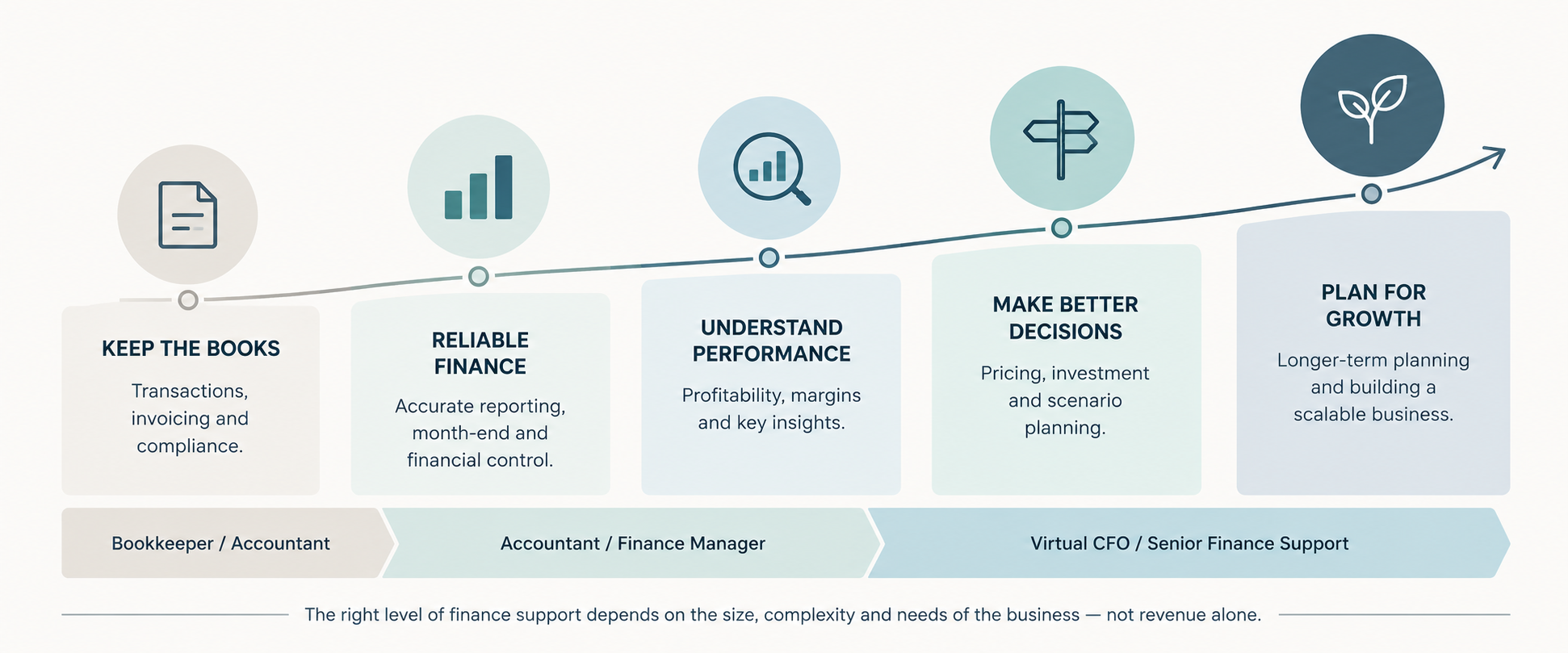
When does a business need a Virtual CFO?
There isn't a particular revenue number at which a business suddenly needs a Virtual CFO. Complexity matters just as much as size.
More customers, products, services, projects, employees, locations, suppliers and systems create more financial complexity. Decisions become larger, more cash may be tied up in the business and small changes in margin can have a much bigger impact. A $5 million business with multiple products, customers, employees and complex operations may need more sophisticated finance support than a much larger but simpler business.
Not every growing business needs a CFO. A smaller business may need stronger bookkeeping, accounting or financial control first. Another may already have good day-to-day finance capability but need experienced support around forecasting, profitability, investment or important business decisions.
The question is less about reaching a particular size and more about whether the finance capability you have today is giving you what you need to run the business you're becoming.
What can a Virtual CFO actually do?
1. Get the numbers right
Before sophisticated analysis or strategic planning, you need numbers you can trust.
That means having appropriate financial processes and controls behind the accounts: revenue and costs recorded in the right periods, reconciliations completed, month-end adjustments made and management reporting produced consistently.
In one business I worked with, inconsistent recognition of revenue and costs caused margins to fluctuate significantly from month to month. The accounting wasn't giving the owners a reliable picture of underlying performance. Strengthening the month-end processes produced much more reliable reporting and margin information.
The benefit: you can spend less time questioning whether the numbers are right and more time using them to run the business.
2. Understand what's really driving performance
A P&L can tell you whether the overall business made money. It doesn't necessarily tell you where it made money.
As a business becomes more complex, it becomes increasingly important to understand profitability by customer, product, service, project, channel or location.
A large customer can generate significant revenue but also require substantial discounts, servicing or other costs, making its profitability very different from what the headline sales figure suggests. Similarly, the highest-selling product or service isn't necessarily the one creating the most value.
A Virtual CFO can help you understand profitability at the level that matters for your business. Whether that's by customer, product, service, project, channel or location, and use that information to make better decisions.
The benefit: growth can be directed towards the parts of the business that are actually creating value, rather than simply generating revenue.
3. Make better pricing decisions
Pricing becomes increasingly important as a business grows.
A seemingly small change in selling price or underlying costs can have a significant impact when applied across a larger customer or revenue base.
A Virtual CFO can help you understand what sits behind your pricing: the cost to serve a customer, the margin you're making, the volume you need to break even and the impact of different pricing scenarios.
That doesn't mean the Virtual CFO decides the price. Customers, sales strategy, market conditions and competitive positioning all matter. Their role is to make sure you understand the financial impact before making the decision.
The benefit: pricing decisions can be made with a clear understanding of their impact on margin and profit rather than relying solely on sales volume or percentage mark-ups.
4. Model important decisions before committing
Growing businesses continually make investment decisions. Should we employ another person? Buy equipment? Enter a new market? Launch a new product or service? Change supplier? Invest in technology?
The relevant question isn't simply, “Can we afford it?”
Before committing, you may need to understand the expected return, payback period, cash requirements, risks and what needs to happen operationally for the investment to succeed. A financial model doesn't predict the future. It makes the assumptions behind a decision visible and allows you to test them.
The benefit: major decisions can be evaluated before cash and resources are committed.
5. Understand what happens when circumstances change
Business plans rarely unfold exactly as expected. Costs increase. A major customer is lost. Demand changes. Exchange rates move. A new competitor enters the market. Scenario modelling allows you to ask:
What happens if this changes and what could we do about it?
In one business I worked with, a major change combined with rising costs materially altered the original outlook. We rebuilt the forecast around key operational drivers, modelled alternative scenarios and worked through the possible responses with the owners. The result was a much clearer understanding of the potential profit and cash impacts, the options available and what each would mean for the business.
The benefit: you can respond to change earlier, rather than discovering the financial impact months later.
6. Forecast where the business is heading
A budget often becomes outdated quite quickly in a growing business. A forecast should evolve as the business changes, incorporating what you now know: current sales, new customers, changed pricing, recruitment plans, costs, capital expenditure and other operational assumptions.
A good forecast connects what is happening in the business with the expected financial outcome. That means it can answer much more useful questions than “Are we ahead or behind budget?”
It can show where revenue, profit and cash are heading and highlight potential issues early enough to do something about them.
The benefit: you gain greater visibility of what's ahead rather than relying predominantly on historical results.
7. Connect today's decisions to the longer-term plan
Eventually the conversation moves beyond next month or even next year. Where are we trying to take the business?
If the objective is to double revenue over five years, for example, what needs to be true for that to happen? How many customers, products, services or locations might be required? What margin needs to be maintained? What people, systems, working capital and investment will growth require?
A longer-term financial model doesn't need to predict the exact P&L five years from now. Its value is in testing whether the strategy is financially and operationally plausible. It also connects strategy with today's decisions. Hiring, pricing, investment and process improvements can then be considered in the context of where the business is trying to go.
The benefit: the financial plan becomes part of business strategy rather than an annual budgeting exercise.
The right finance support depends on the business
A Virtual CFO isn't necessarily the answer for every growing business. The right support depends on the problems you're trying to solve, the capability you already have and where the business is heading.
For some businesses, senior finance support is needed for a particular project or decision. For others, the questions around performance, forecasting and growth arise regularly enough that an ongoing Virtual CFO relationship makes more sense.
The important question isn't simply, “Do I need a Virtual CFO?”
It's “Does the finance capability we have today give us what we need to run the business we're becoming?”
As a business grows, finance should grow with it.
Angela Amar, CA
Founder | Prokopi Advisory