
What Extreme Growth Taught Me About Cost Control
Lessons from a period of extraordinary growth

Case Study | July 2026
How stronger systems and financial visibility helped regain control. And why the same lessons apply to growing businesses today
Earlier in my career, I worked inside a large organisation going through a period of extraordinary growth. It was still a young organisation when I joined, and transaction volumes and costs grew from a modest starting point into hundreds of millions within a few years.
That kind of growth curve is rare, and it's not really the point of this piece. What matters is the pattern behind it, because the underlying problem I saw play out at that scale is exactly the same problem I now see in growing businesses at a fraction of the size, and the lessons translate directly.
The problem was never the growth. It was that the processes and systems didn't grow with it
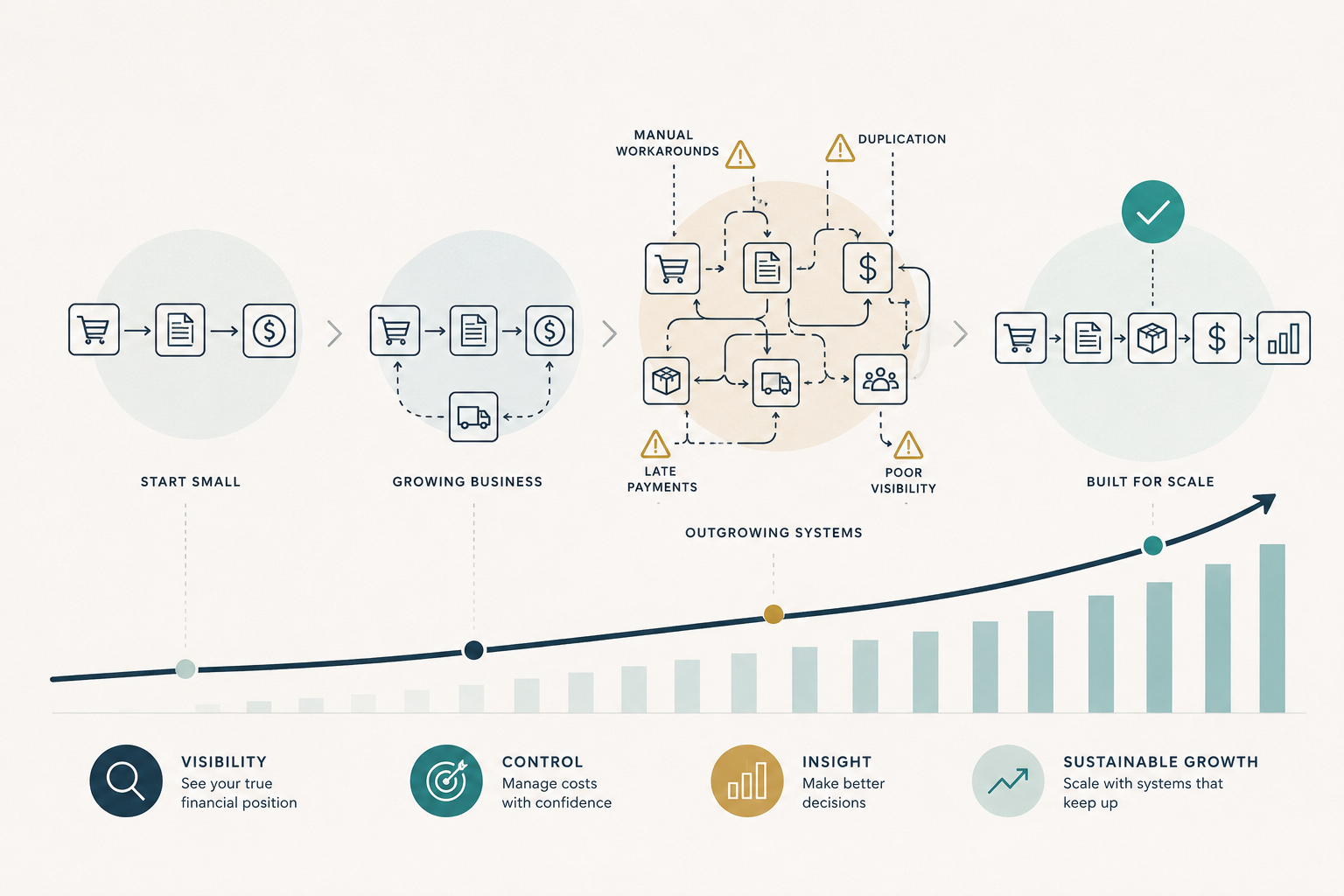
This is a pattern I've seen play out in fast-scaling organisations more than once, and it's rarely anyone's fault. The processes that work fine at a smaller scale are rarely built for the volumes that come with fast growth. Most organisations don’t design their systems for a scale they haven’t reached yet. The gap only becomes visible once growth outpaces it.
The cracks showed up in predictable ways:
Manual workarounds, and increased resourcing to manage transactions
Duplicated payments, because there was no reliable way to check what had already been paid
Late payments, because approval processes weren't built for the volume moving through them
No real ability to measure or manage revenue or costs, because the data needed to do it wasn't captured consistently
Individually, each of these looks like an operational headache. Together, they point to something more serious: the business didn't actually know its true costs. And that has consequences that go well beyond a messy finance function.
Why "we don't really know our numbers" is more dangerous than it sounds
When you can't see your true financial position with confidence, it doesn't just make reporting harder. It quietly undermines the decisions built on top of it:
Cost blowouts go unnoticed until they're large. Without accurate, timely visibility, small overruns compound for months before anyone catches them.
Tenders and negotiations get built on old or wrong data. If you don't know what something actually costs today, you can't negotiate from a position of strength with suppliers, contractors, or customers.
Results become inconsistent month to month, which makes it nearly impossible to tell whether the business is genuinely improving or just producing noisy numbers.
Cost transparency breaks down for leadership, for boards, for anyone trying to make a confident call on where to invest or where to pull back.
This is the real cost of outgrowing your systems. Not the duplicated payment itself, but everything downstream that gets built on inaccurate information.
What actually fixed it: two tracks, running at the same time
My role had two distinct parts, and I think the distinction matters for any business facing this problem.
First, keep the lights on. Before anything else, we needed an interim way to manage project cost control that didn't wait for a perfect long-term fix. This wasn't glamorous work, nor was it sustainable. It was about getting a workable, honest read on cost control right now, with the tools and time available.
Second, build something sustainable. In parallel, I worked with the systems, operations and finance teams on a proper, long-term solution: a purpose-built work management system integrated with the finance systems. This is what ultimately delivered real visibility, better reporting, consistent data, and the ability to actually manage cost rather than just record it after the fact.
The order matters. Trying to jump straight to the perfect system without stabilising the interim mess has its problems. There's no clean data to migrate, and the business is still bleeding costs while the "real" fix gets built which can often take years. But stopping at the interim fix and never addressing the underlying system means the same problems resurface at the next stage of growth.
Where this shows up in growing businesses
I don't expect most business owners to ever manage spend on that scale. But I see this exact pattern constantly in businesses, regardless of the size:
A business that scaled revenue quickly but is still running finance the way it did in year one. Spreadsheets, informal approval processes, reporting that's more gut feel than data driven
Owners who think they know their margins, but couldn't confidently defend the number if asked
Pricing and quoting decisions being made on cost assumptions that haven't been checked in a year or more
Month-to-month numbers that jump around in ways nobody can quite explain
The scale is different. The underlying issue is the same: systems and processes that haven't kept pace with growth.
The lesson I took from it
Fixing this isn't really a finance problem. It's a cross-functional one. The interim fix required working closely with teams who understood where the money was going. The long-term fix required systems, finance, and leadership all moving in the same direction.
My job wasn't just to report the numbers. It was to work across those teams to build the systems and processes that made good numbers possible in the first place and then work with leadership to turn that visibility into real cost control and better decisions.
That's the same approach I now bring to growing businesses through Prokopi Advisory, whatever the scale. Get a clear, honest read on where things stand today, then build the reporting and processes that let you make confident decisions as you keep growing, instead of finding out six months later that the numbers you were relying on weren't quite right.
If any of this sounds familiar, and growth is starting to outpace your current setup, I’d be glad to talk it through.
Angela Amar, CA
Founder | Prokopi Advisory