
The Customer That Looked Like Your Best
But Was Costing You Money

Case Study | April 2026
Every great customer deserves a closer look
Every business has a customer everyone's proud of. A big name, strong sales, years on the books. On the sales report, they look like a highlight, not a problem.
I once worked with a large consumer goods business supplying a major retail customer where exactly that was true. It took a deep look at the numbers to discover the account wasn’t making money.
What looked fine on the surface
The customer made up around 5% of the business unit's revenue. Large enough to matter, and large enough that no one wanted to touch it. Sales were healthy. On a top-line report, this looked like one of the accounts worth protecting at all costs.
But the business wasn't reviewing full profitability by customer on a regular basis. Contribution margin was tracked holistically, across the business, not broken down customer by customer. It took a tender, which forced a full profit-and-loss review to actually ask the question properly. Once you accounted for the cost of goods, the rebates and discounts, and overheads, was this customer actually making money?
The answer was no. Once everything was allocated properly, the account was running at a loss.
How a profitable-looking customer becomes a loss-making one
This wasn't the result of one bad decision. It built up gradually, and it's a pattern worth understanding because it's common, not because anyone did anything wrong.
Sales teams are very often incentivised on revenue and volume. Which makes sense, since growing the top line is genuinely valuable. The natural response to a customer pushing for a better deal is to say yes. A bit more discount here, a slightly better rebate there, all reasonable in isolation, all aimed at protecting a valuable relationship. Over time, those individually sensible decisions can quietly compound into a customer that costs more to keep than it earns.
The team involved in this case genuinely cared about getting it right once the numbers surfaced. They wanted to retain the customer, and worked hard on ways to make the relationship profitable rather than simply walking away. Exploring range expansion, looking at ways to reduce input costs, thinking through every lever available. That collaboration mattered. Finding the real number is only half the job. Working through what to do about it is the harder part, and it works best done together.
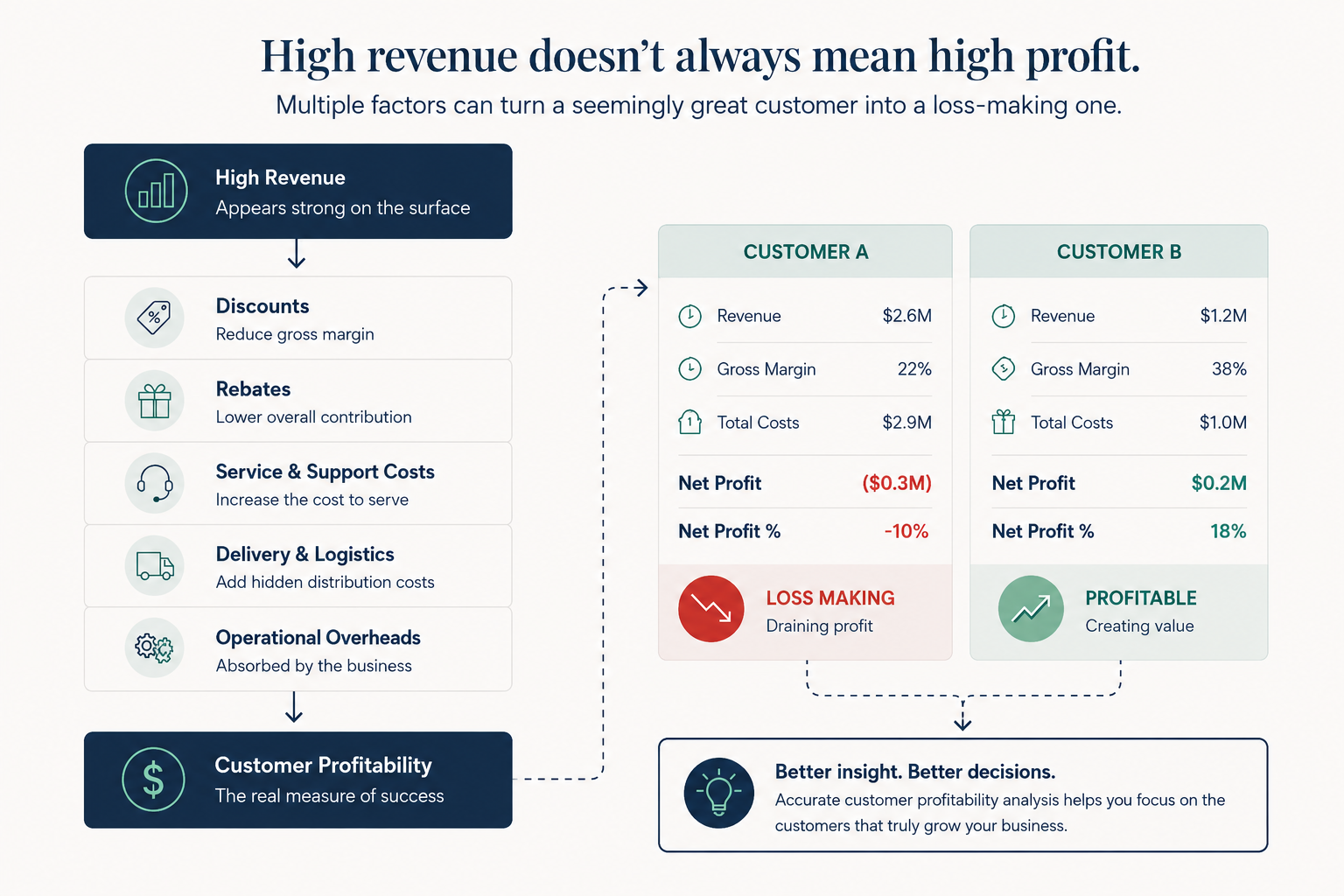
Illustrative example only. Figures have been simplified for demonstration purposes.
Finding the real picture
Once the loss was identified, the next step was working out whether it was fixable. This meant modelling the customer account properly. Not a single number, but a set of scenarios built out to answer specific questions:
1. What's the maximum discount and rebate level the business could sustain and still be profitable on this account?
2. Where could costs or overheads realistically come down?
3. Could the shortfall be absorbed elsewhere in the business, and was that actually a fair or sustainable thing to do?
That last option, quietly recovering the loss by spreading it across other profitable customers, was on the table. It's tempting, because it makes an uncomfortable problem disappear on paper. But it doesn't fix anything. It just moves the loss somewhere less visible, and it penalises the customers who were paying a fair price to begin with.
Working through the scenarios with the sales team, modelled out in detail, made it clear this wasn't a pricing tweak away from profitability. It needed a genuinely different deal.
The decision
The business took the numbers back to the customer and asked for a renegotiation. The customer said no.
That left two options:
Keep the customer, keep the revenue, and the top-line sales report keeps looking good, while the business continues losing money on the account, quietly, every month.
Or let the customer go, lose the sales figure, and improve the bottom line.
On paper, losing a large customer sounds like the harder call. In practice, once the real numbers were in front of everyone, it wasn't. A customer that costs you money isn't a customer. It's a liability wearing a familiar logo. The business let it go and focused the effort that had gone into protecting that relationship on building and expanding elsewhere instead.
It was still a hard decision to reach. Letting go of a long-standing customer never feels comfortable, no matter how clear the numbers are. But it was the right one.
The lesson for growing businesses
Revenue tells you what's coming in. It doesn't tell you what you're keeping.
A business can be growing sales every year and still be losing money on its biggest customer. Without a clear view of profitability by customer, it’s difficult to know the difference between a customer worth protecting and one worth letting go.
You don't need a formal tender to force that question. Reviewing customer profitability regularly helps you spot the issue early, before it becomes a much harder decision.
If you're not sure whether your biggest customer is your most profitable one, that's usually a sign worth taking seriously. I'd be glad to talk it through.
Angela Amar, CA
Founder | Prokopi Advisory