
The Value of a Forecast
Why forecasting became one of the business's most valuable decision-making tools
Case Study | August 2026
How Regular Forecasting Helped One Small Business Navigate Uncertainty
Most business owners can tell you what happened last month. But fewer can tell you what the next three months are likely to look like, or what happens to the rest of the year if something unexpected changes.
Throughout my career in large organisations, forecasting was at the centre of planning and decision-making. It was reviewed regularly, updated as circumstances changed, and used to make better decisions.
Working with a small business over the past few years, I brought that same discipline. We closed the numbers properly each month, maintained a rolling forecast, and reviewed it every quarter.
The result was a business that wasn't constantly reacting to surprises. The owners understood what was coming, could see the financial impact before making major decisions, and had far greater confidence in the direction of the business.
Forecasting starts with reliable numbers
A forecast is only as good as the numbers behind it.
Before we could rely on the forecast, we first had to make sure the month-end numbers were accurate and consistently delivered. Once that foundation was in place, we could build a rolling forecast that reflected where the business stood today, not where it was six months ago.
The forecast became part of the business's regular reporting reviews. It was updated as conditions changed and used to support everyday decisions. Over time, the owners stopped seeing the forecast as another finance report. It became the first place they looked before making an important decision.
Here are five real situations the business faced over several years, and how regular forecasting helped us respond with confidence.
Scenario one: A supplier increased prices by 20%
One of the business's major suppliers announced a +20% price increase across core products.
Because the forecast was already up to date, we could immediately model the impact across the full financial year. The business knew exactly how much additional cost it was facing, how much margin needed to be recovered, and how much time it had to source an alternative supplier before profitability started to suffer.
Instead of wondering how bad the impact might be, the owners knew exactly what they were dealing with and could focus on finding the best solution.
Scenario two: Fuel levies continued to rise
Fuel levies have increased by around 30 to 40% as a result of the Middle East conflict, adding roughly 5% to freight costs. Further increases were expected throughout the year, adding further uncertainty.
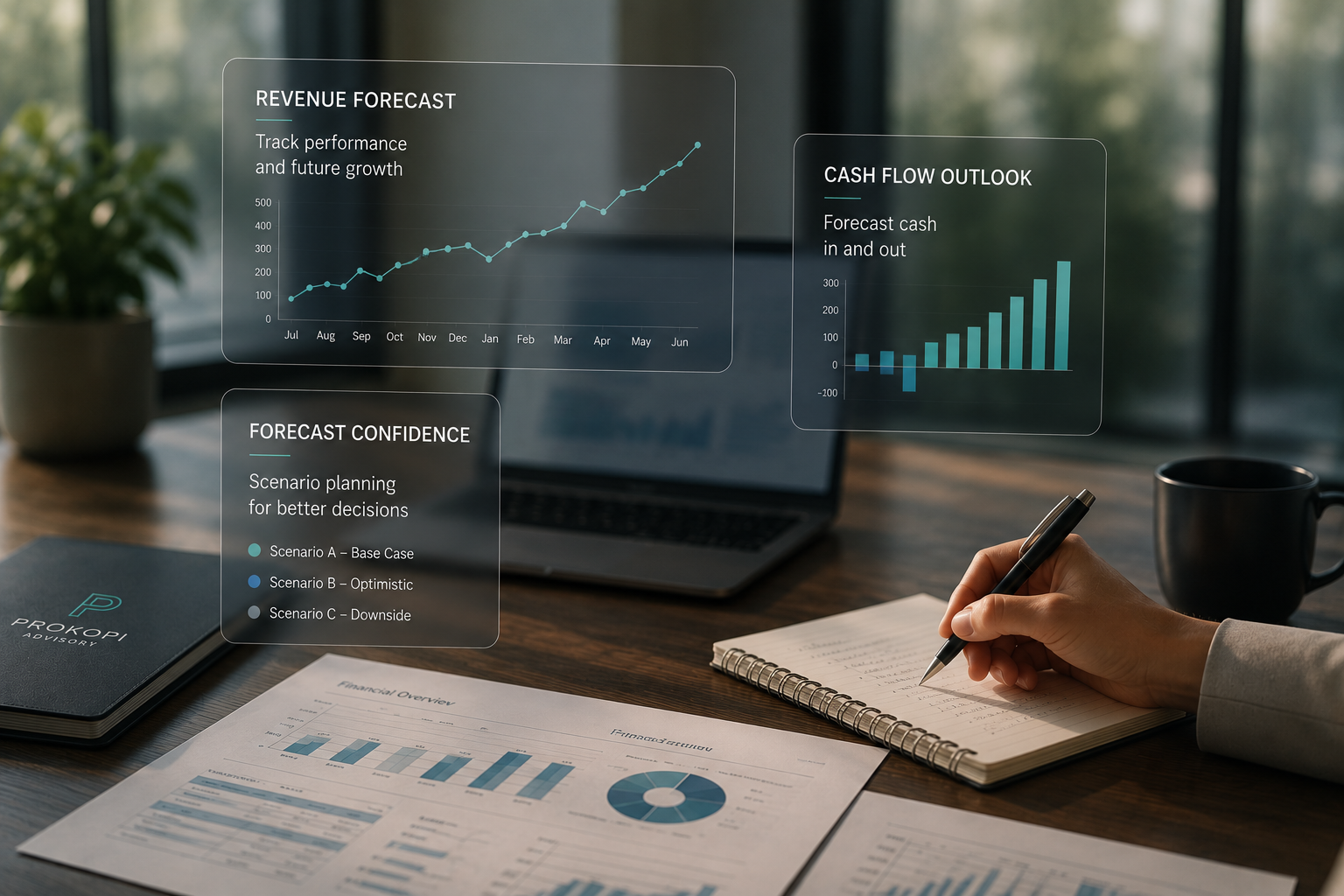
Rather than treating each increase as another difficult month, we modelled several scenarios across the remainder of the year. That gave the business a clear understanding of the possible outcomes and allowed management to consider different responses before decisions became urgent.
The uncertainty didn't disappear. But it became measurable.
Scenario three: Losing a customer
Losing a customer is always stressful. When it happened, the forecast gave the business insight into what that loss meant for revenue, profitability and the full-year outlook. As a result, management could focus on the right questions. Was the customer profitable? Should effort go into winning them back? How much new business needed to be secured to replace the lost revenue?
During periods like this, the forecast becomes a powerful tool. It cuts through the noise and lets the business respond quickly and with confidence, rather than staying stuck in the unknown.
Scenario four: Hiring with confidence
At one point the business was weighing up whether it could afford to bring on an additional staff member. Too often, businesses start increasing headcount way too soon. Instead of relying on a few strong trading months, we tested the decision against the full-year forecast. We looked at the impact on profitability, cash flow and available buffer under different trading scenarios.
Hiring became a decision backed by evidence, not optimism.
Scenario five: Testing every major investment
The forecast also became the lens for every significant spending decision. New equipment, leases, marketing investment and other major purchases were never considered in isolation. Each one was tested against the full-year outlook before any commitment was made.
That helped ensure every investment supported the long-term financial position of the business, rather than simply reflecting confidence after a good month.
What regular forecasting really delivers
None of these events were predictable. A supplier increased prices. Fuel costs rose. A customer was lost. The business continued to grow and invest. What made the difference wasn't avoiding those events. It was already having a current forecast that could immediately show what each one meant for the rest of the year.
That's the real value of regular forecasting. It doesn't predict the future. It gives business owners the confidence to make decisions, even when the future is uncertain.
If your business has experienced one of these moments without a clear number to work from, it may be a sign that your forecasting process needs more than an annual budget. A regularly updated forecast can become one of the most valuable decision-making tools in the business.
Good forecasting doesn't remove uncertainty. It gives you confidence despite it.
Angela Amar, CA
Founder | Prokopi Advisory